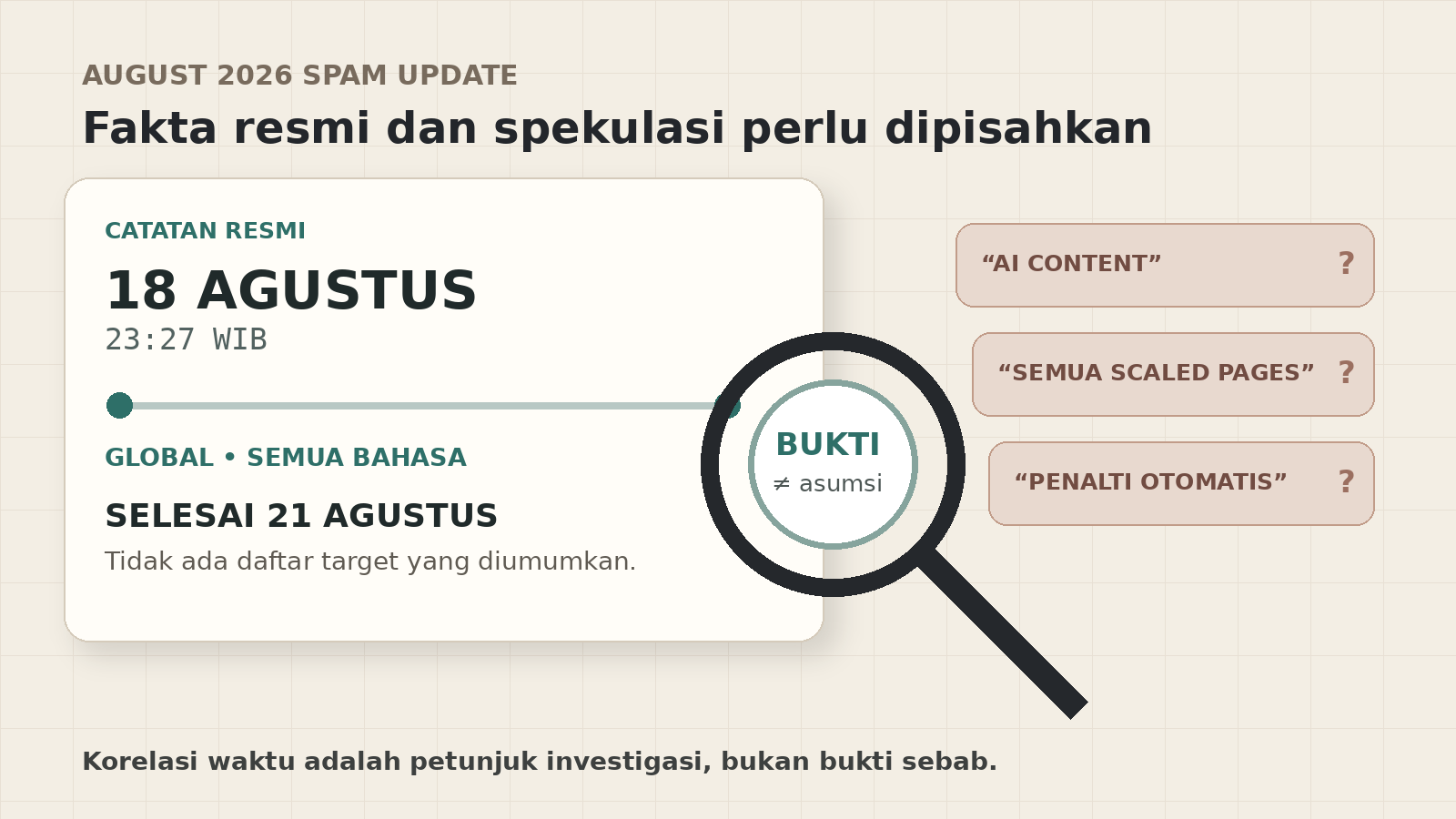
Google started a global spam update on August 18, 2026, at 9:27 a.m. Pacific time. It finished on August 21 at 1:49 a.m. The public incident record does not name AI content, scaled content abuse, link spam, or any type of website as a special target.
The supported answer is narrower than many headlines: Google has not officially said that the August 2026 spam update targeted AI content as a category. Existing policy can still penalize pages produced at scale—including pages made with generative AI—when their main purpose is manipulating rankings and they add little value. A policy's coverage, however, is not the same thing as a rollout's disclosed target list.
That distinction matters for site owners investigating an August ranking drop. Timing provides a useful place to begin an audit. It does not establish the cause, much less prove that Google penalized a page because AI assisted its production.
The official announcement is shorter than the conclusions around it
The Search Status Dashboard records the August 2026 spam update as a rollout lasting 2 days and 16 hours. Machine timestamps cited in coverage of its completion place the incident between 09:27 PDT on August 18 and 01:49 PDT on August 21. The precise interval was about 2 days, 16 hours, and 22 minutes; the dashboard rounds it to 2 days and 16 hours.
| Time | Event | Evidence strength |
|---|---|---|
| Aug. 18, 09:27 PDT | Ranking incident began according to the status timestamp | Dashboard and status feed |
| Aug. 18, about 09:28 PDT | Google said the update applied globally and to all languages | Official statement |
| Aug. 21, 01:49 PDT | Google marked the rollout complete | Official statement |
| Aug. 31 | The official record still did not identify AI content as a target | Boundary of the public record |
Google's general spam update documentation describes these updates as significant improvements to its automated spam-detection systems. The same page identifies SpamBrain as an AI-based spam-prevention system. That explains part of the detection machinery. It does not show that AI-written content was the August update's special target.
| Confirmed | Not disclosed |
|---|---|
| Rollout ran from August 18 to 21 | Classifiers or signals that changed |
| It applied globally and to all languages | Share of affected queries |
| Google classified it as a spam update | Policy set refreshed by the rollout |
| Google's spam systems are automated | Proportion of human, AI, or mixed-production pages that lost visibility |
| Recovery can require months of reassessment | Proof that one site's loss came from this update |
Search Engine Roundtable's Barry Schwartz reported that Google said this was not a link-spam update, did not involve every spam policy, and had no disclosed query-impact percentage. Those details narrow the possibilities without naming AI as the target. Because the statements came through Schwartz's reporting, they belong as attributed reporting rather than as words displayed on the dashboard.
AI appears in Google's policies, but a policy is not a target list
Google's spam policies define scaled content abuse as creating many pages mainly to manipulate search rankings rather than help people. The examples explicitly include using generative AI to create many pages without adding value. The policy also covers attempts to manipulate generative AI responses in Google Search.
At the same time, Google's guidance on generative AI content says AI can help with research and the structure of original material. The production tool is not the deciding factor. Scale, manipulative intent, accuracy, quality, relevance, and the value delivered to readers are. Google's March 2024 policy explanation makes the same boundary explicit: scaled abuse can involve automation, people, or a combination of both.
| Production pattern | What the policy supports |
|---|---|
| AI assists research, structure, or editing | Not automatically spam; the result still needs accuracy, relevance, and value |
| Thousands of AI pages repeat query variations | Can qualify as scaled content abuse when ranking manipulation is the main purpose |
| Thousands of low-value pages are written by people | Can violate the same policy; automation is not required |
| Pages try to poison answers in AI-powered Search | Can violate policies against manipulating Search systems and generative responses |
| One AI-assisted article adds evidence, analysis, and corrections | Its production method alone does not prove a violation |
Google's AI feature optimization guide adds another practical limit. Separate pages built for every query variation or fan-out query can violate scaled content rules when their purpose is manipulating rankings or AI responses. The relevant object remains the manipulative pattern and commodity content, not a simple “written with AI” label.
Three different layers turn a possibility into a false certainty
Some explanations take Google's policy list, select scaled content abuse, and present it as the target of the August update. The connection sounds plausible because Google does have policies covering AI-assisted spam. One evidentiary step is still missing: Google did not publish the set of policies or classifiers changed by this rollout.
- Official fact: a global spam update ran from August 18 to 21.
- Policy context: scaled content abuse can include mass AI production that adds no value.
- Reasonable inference: the update may improve detection of some patterns covered by that policy.
- Unsupported claim: the update was designed to target all AI content or every “AI content farm” as one category.
The inference can remain a hypothesis. Trouble begins when the word may disappears and the hypothesis moves into a headline as fact. The absence of the term AI from the announcement does not prove that no AI page was affected. It sets a narrower limit: a special AI target was neither announced nor established by the public evidence.
Another late-month change can easily become mixed into the story. On August 28, Google updated enforcement of its site reputation abuse policy in the European Economic Area, including how manual actions would apply from August 30. That change has its own date, region, and enforcement mechanism. It cannot be used retroactively as the target list for the automated August 18–21 rollout.
Volatility data shows disruption, not motive
One widely cited early measurement came from SE Ranking and was reported by Search Engine Land on August 27. In a comparison of 100,000 United States keywords across 20 industries, 16.71% of URLs that had ranked in the top 10 fell beyond position 100 during the update window. The July comparison window recorded 9.2%. That is a 7.51 percentage-point difference, or roughly an 81.6% relative increase.
| Measure | Update window | July baseline | Limited meaning |
|---|---|---|---|
| Top-10 URLs falling beyond position 100 | 16.71% | 9.2% | Severe movement appeared more often during the update window |
| Relative increase | About 81.6% | Reference | It is not an 81.6 percentage-point change |
| Sample | 100,000 United States keywords in 20 industries | Comparison window | It does not represent every country, language, or query |
The study did not classify sites by AI usage, audit the losing URLs or domains, or track positions beyond 100. The measurement treats a move to position 101, a fall to 500, a canonical change, and removal from the index identically. The data supports unusual SERP churn. It cannot identify what the update targeted.
Ranking drops that overlap in time can still have different causes
Community reports show why attribution needs restraint. In one Google Search Central Community thread, a site owner reported a broad loss around August 16–18. A Product Expert pointed to the new update but also found 404 pages and very short articles. The timing, technical faults, and content-quality concerns existed together; the thread could not isolate one cause.
Another thread described Search Console clicks and impressions falling to zero while pages still appeared in high live-search positions and the indexed-page count rose. That pattern is more consistent with delayed or anomalous reporting than lost rankings. Community posts document firsthand experiences, not Google judgments about a site.
A news platform discussion also began with a drop that coincided with the rollout. The discussion soon moved to scraped material and the value added beyond source RSS feeds. That makes policy a useful audit checklist. It still does not show that the update was specifically looking for AI content.
A sound diagnosis starts with the timeline, not a guessed target
Google's own traffic-drop guidance says organic search losses can have many causes: algorithmic changes, technical problems, security issues, spam, shifting demand, seasonality, and site migrations. It also advises checking data anomalies and logging errors before treating a chart as proof of a ranking change.
A practical audit for a post-update decline can follow this order:
- Mark the hour the decline began. A clear loss before August 18 at 09:27 PDT cannot have been triggered by a rollout that had not started.
- Compare equivalent date windows. The August 18–21 rollout should be separated from the periods before and after it rather than hidden inside one weekly average.
- Segment by page, query, country, device, search type, and search appearance. The Search Console API supports these dimensions and filters, although it does not guarantee every detailed row.
- Compare impressions, clicks, CTR, and position together. Stable impressions with fewer clicks require a different diagnosis from simultaneous losses in impressions and position.
- Check Manual Actions, Security Issues, Page Indexing, URL Inspection, crawl statistics, server logs, robots.txt,
noindex, canonicals, redirects, and deployment changes. - Find patterns among affected pages: directory, template, language, author, data source, content length, or a shared generation process.
- Map the observed pattern to the policy whose definition fits. Scaled content, scraping, doorway pages, cloaking, and link abuse are not interchangeable labels.
- Keep a dated change log. Without dates and reasons, later movement cannot be separated from the effect of a fix.
The Search Analytics API can group data by page, query, country, device, date, and search appearance. Its documentation warns that internal limits return top rows rather than every possible detailed row. Google also explains that adding page or query dimensions increases detail while making some data less likely to appear. A causal claim should not rest on an export that is assumed to be complete when the API says otherwise.
| Observed pattern | Initial hypothesis | Next check |
|---|---|---|
| Impressions, clicks, and positions decline | Visibility changed | Page/query clusters, index state, templates, and applicable policies |
| Clicks decline while impressions remain stable | CTR, SERP features, or intent shifted | Titles, snippets, search appearance, and demand |
| Search Console shows zero while live rankings remain | Reporting lag or anomaly | Data Anomalies, latest dates, and a second measurement source |
| Analytics traffic falls while Search Console remains stable | Tracking or site behavior changed | Tags, consent, channel classification, and landing pages |
| One country or device declines | Local or device-specific change | Country/device filters and rendering checks |
| A Manual Action appears | A named manual enforcement action exists | The report details, remediation, and reconsideration process |
Recovery starts with a demonstrated problem, not a mass deletion
Google's spam update documentation tells affected sites to review its spam policies. Improvements can emerge after the system learns over several months that a site has returned to compliance. That is neither a fixed timeline nor a promise that previous rankings will return.
Manual actions and automated evaluation also need separate treatment. Google explains that automated systems identify violations and human review can produce a manual action when needed. Search Console displays a Manual Actions report for actions that were issued. A clean report means no visible manual action; it does not rule out an algorithmic change. Reconsideration requests apply to manual actions, while recovery from an automated spam update depends on fixing policy violations and waiting for reassessment.
The riskiest response is deleting or rewriting every AI-assisted article because a graph fell near the rollout date. A mass change can remove useful pages, obscure the diagnosis, and introduce new technical errors. The audit should follow observable patterns: pages without original value, repeated query variations, scraping, doorway structures, inaccurate automated metadata, or attempts to manipulate Search and AI-generated answers.
AI can be used for spam, but a special AI target remains unproven
The official record establishes that Google ran a global spam update from August 18 to 21 and that its systems can evaluate many manipulative patterns. Google's policies also establish that mass generative-AI content without added value can violate scaled content rules.
The available record does not establish that the August update was designed specifically to punish AI content, that every site losing visibility violated policy, or that one domain's decline came from this rollout. Google has not disclosed the classifier, refreshed policy set, query share, or production method of the pages that lost visibility.
The most defensible next step is to compare the site's timeline with the official rollout record, read the spam policies by their actual names, and export a Search Console baseline before making broad changes. The AI-target claim would need a specific Google statement or classified data directly connecting the rollout to that production method before it could be stated as fact.
Loading reader comments...